

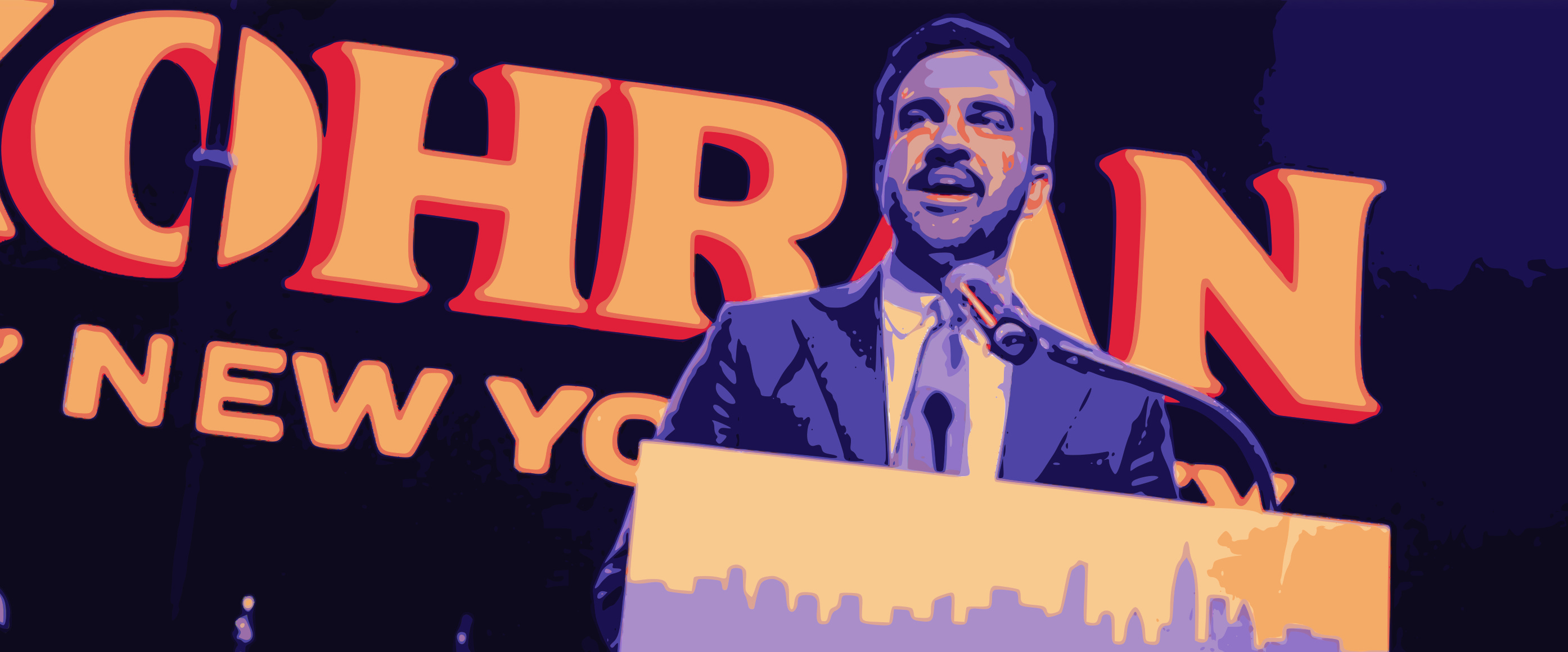
I’ve been writing about the split in the Democratic Party between corporatists and progressives1, and what I hope is a growing economic populist movement. Zohran Mamdani’s victory in New York yesterday is the marquee story of these shifting winds, perhaps because people see it as the most surprising one, an underdog triumph. He’s a young Muslim with scant political experience, an unapologetic Democratic Socialist and a loud critic of Israel’s campaign in Gaza. That’s a lot that would normally go against a candidate in New York City, and although we shouldn’t ignore the fact that his opponent, Andrew Cuomo, is a uniquely odious dude, Mamdani’s win was just one of a number of big victories for Democratic candidates yesterday.
There are plenty of takes about the election results—how it is a repudiation of the Trump Administration (I agree); how the Democratic Party is back, baby! (I disagree)—but I thought I would offer my own.
Mamdani made affordability the biggest issue of his campaign, and he was relentless in his focus on it. That made it hard for the opposition to stick other issues on him, and it might have helped sanitize the label “socialist,” since he readily accepts it. However, other Democrats who won, including ostensible moderates like Mikie Sherrill and Abigail Spanberger, also seemed to understand the power of focusing on affordability. Here’s Mikie Sherrill during her campaign:
I am fighting for you. I’m fighting for affordability. I’m fighting to get your costs down. I’m declaring a state of emergency on day one, freezing utility rate hikes… I’m not doing a ten-year study. I’m not writing a strongly-worded letter. I’m not gonna convene a group…
In that same speech, she went on to talk about expanding the first-time home-buyers’ program and taking on “those landlords who are colluding to drive up your rental prices.” If Sherrill and other moderate Democrats are sincere about addressing the affordability crisis, then I say welcome to the movement! But that question of sincerity is what I really want to talk about.
It brings me to Gaza, the other issue where Mamdani stood out from the other candidates. Among the mayoral candidates, he was the only clear “no” on Israel’s actions, the only one to call it a genocide. Cuomo made much of this of course, appealing to the line that conflates Israel with Jews and judaism, where criticizing Israel amounts to antisemitism. This might have worked better on voters a few years ago. Here’s John Ganz:
The terrible images of death and destruction from Gaza made Mamdani’s stance on Israel-Palestine go from fringe to reasonable. Israel’s place in American politics was more the unquestioned status quo than ideological, even for many Jews. It was a given, it was the accepted wisdom, that Israel was more or less okay and a friend… Then there was Gaza… And so Mamdani’s views rapidly go from being an eccentric force in American politics to a central one.
Cuomo tried another angle to neutralize Mamdani’s support on this issue, which was to point out that the mayor of New York City isn’t in a position to change Middle East policy and therefore shouldn’t waste time talking about it. But he misses the point. New Yorkers understand this perfectly well. Voters just want politicians who have the courage and integrity to acknowledge obvious truths.2
It seems like literally the lowest bar: being able to say a thing is what it is, to acknowledge objective reality without equivocation and with moral clarity. It’s not unreasonable and it shouldn’t be difficult. It doesn’t mean abandoning nuance, but nuance can come afterwards. First say the thing is what it is, and then go ahead and talk about complexity and degrees and the difficult trade-offs in addressing the problem.
A few weeks ago, Cory Booker appeared on the “I’ve Had It” podcast, and host Jennifer Welch asked him if Benjamin Netanyahu is a war criminal. Instead of answering the question, Booker filibustered and deflected and got a lot of flack for it afterwards. People get hung up on labels like “war criminal” or “genocide,” and it makes sense. Labels are both loaded and imprecise. Still, I think Booker should be able to answer a question like this unequivocally and with moral clarity, even if he decides to sidestep the label.
The political figures on the left whose profiles are rising are the ones who can pass this simple test. Can they say what is obvious to everyone else, about Israel and Gaza, about one percent of Americans hoarding too much wealth, about corporations having too much power over our lives. With Gaza, the test is about moral clarity. With wealth inequality and affordability, the test is about objective reality and the courage to speak truth to power, to bite the hand that thinks it owns you.
Once again, I don’t love the term progressives. “Democratic Socialists” might be a better term in that it is somewhat descriptive, but then ‘socialist’ is a loaded term that is misunderstood by many and intentionally muddied by many others.
Voters on the right seem to want something different. When Mike Johnson brazenly lies, or Pam Bondi defiantly refuses to answer questions, or Karoline Leavitt lashes out at reporters, or when no Republican will say that Trump lost the 2020 election (still!), they are signaling in-group loyalty. With their voter base, they get points for loyalty, not truth or moral clarity.
I think progressive populist is the best term for the movement at hand given the older voting block’s propensity to recoil anytime the word socialism is used. Luckily that narrative seems to be dying with traditional media.
Unfortunately, I feel the progressive populist movement will forever be fought tooth and nail by the centrist democrats because they have become addicted to corporate/lobbyist money. I believe the reason why centrist democrats have “failed to deliver” for the average American is because they have been specifically incentivized to do so. AIPAC is a great example of that, having been a top donor to both Rep and Dem party leadership.
I believe most younger Americans (regardless of party affiliation) understand that neither party is really working for them and they are fed up. On the democratic side, it seems we have heard the first rumble of the coming progressive populist movement. Unfortunately for centrist democrats like Schumer and Jeffries, they look at the progressive populist movement as a threat to their entire system of politics. They’re already bought and paid for, will refuse to change, and will get flattened in the process. Willing to bet money on that.