

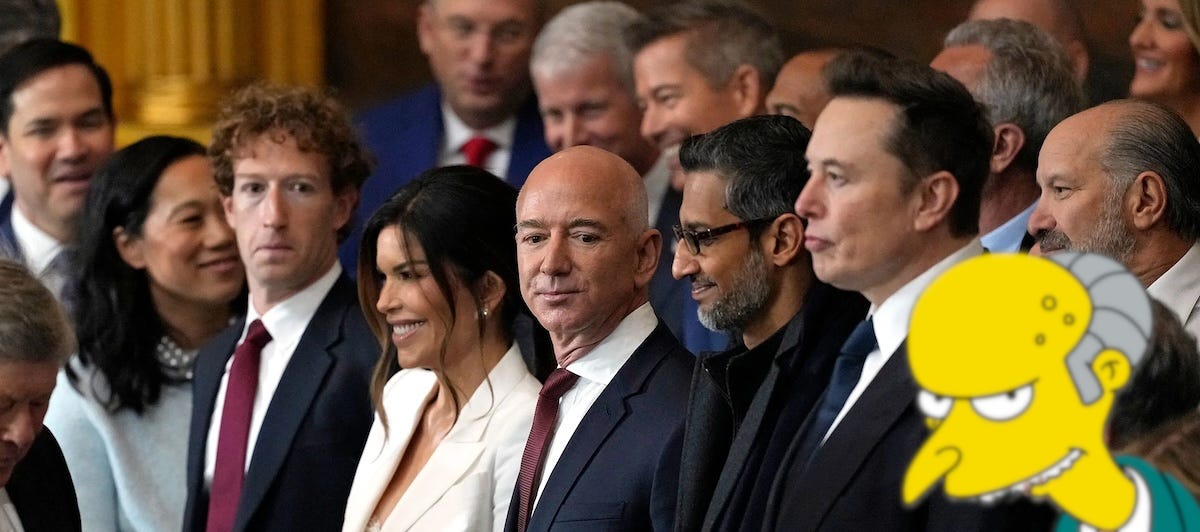
Noah Hawley, creator of the “Fargo” television series, has an excellent piece in the Atlantic about the time he went to Jeff Bezos’s “Campfire” retreat, one in the circuit of mogul-funded ideas festivals. There are so many amazing details in Hawley’s account, but one of his takeaways especially struck me as a perfect expression of an idea that I think about a lot:
…moral reasoning develops through consequences—not punishment, necessarily, but experiencing the effects of your actions on others, receiving honest feedback, having to accommodate reality as it actually is rather than as you wish it to be. It’s not that the wealthy become evil; it’s that their environment stops teaching them the things that nonwealthy people are forced to learn simply by living in a world that pushes back. When you can buy your way out of any mistake, when you can fire anyone who disagrees with you, when your social circle consists entirely of people who need something from you, the basic mechanism by which humans learn that other people are real goes dark.
To these men—mostly they are men—the rest of us aren’t real in the sense of having distinct needs, desires, plans, expectations, responsibilities, relationships, or ideas. Other people exist only minimally as it serves them. An uncomfortable analogy is that people in general exist for these plutocrats much the way that, say, factory workers in Bangladesh exist for the typical American or European. I’ll come back to that.
Andreessen and Musk in particular seem to enjoy referring to the rest of us as NPCs. In video game jargon, an NPC is a non-player character, meaning a character that is not controlled by another player but is part of the game itself—a character without agency in other words. Sometimes NPCs are basically scenery, like extras in a movie; other times they play minor but useful roles in transactions, quests, fights, etc. As a player you generally ignore NPCs, except when they’re needed to move the story forward, or when they’re just in the way, slowing you down.
God Mode is another video game term, meaning a cheat code or hack that makes a player invincible. These plutocrats play the game of real life mostly in God Mode, using extreme wealth as their cheat code to escape not just accountability, and obligation, but all forms of disharmony and friction, no matter how mild. You would think they’d be content simply to declare victory and retire to their private islands, but they are not satisfied because their victory is not yet total. They still encounter people here and there who tenaciously insist on being real humans. We are annoying that way.
It really upsets them to be reminded that God Mode is not (yet) their permanent condition or that not everyone has acquiesced to their worldview. Sometimes their antics are comically petty…
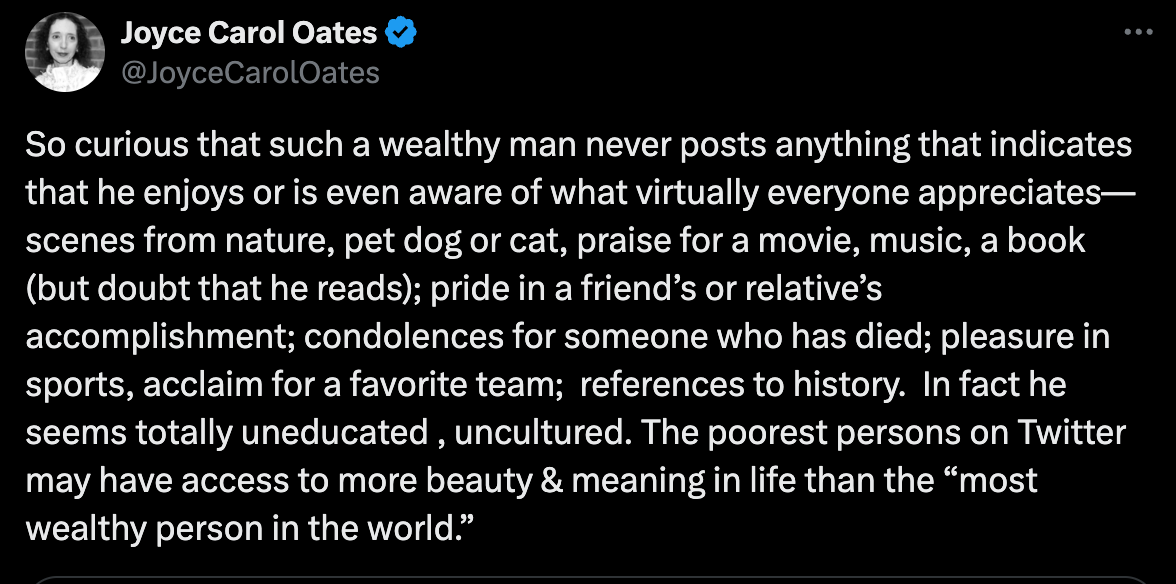
Soon after Elon Musk bought Twitter, he organized a meeting to understand why his own tweets weren’t getting the attention he expected. When engineers walked him through an analysis, he didn’t like what they told him, so he fired them on the spot. Then he ordered a change to the algorithm to permanently boost his own tweets.1 Much more recently, Musk directed a storm of furious replies at novelist Joyce Carol Oates after she roasted him thusly:
It’s not always trivial stuff. In Marc Andreessen’s account of how the Biden Administration suggested a “pause” on certain cryptocurrency allowances in order to “study” the issue before offering its unbridled support, Andreessen characterized it as a “terroristic threat” and a “direct and brutal assault” against the tech industry. He took his tirade on the podcast circuit as he pivoted aggressively pro-Trump. Andreessen has been similarly hyperbolic about workers who have had the temerity to criticize the practices of their employers, like the Google employees who protested the company’s contributions to Project Maven, and workers at various companies expressing discontent about relationships with ICE, private prison firms, etc.
So the plutocrats fight on.
Government is a main front of their war where they have won much ground over decades, often without much of a fight. They have captured courts, lawmakers, and regulating bodies to eviscerate workers’ power and otherwise clear the way for their schemes in advance. They have tailored finance and tax law to minimize their own obligations and maximize their ability to move and hide money, including money they spend on electoral politics. Over and over again they have managed to privatize gains and socialize losses. There are many examples, but the canonical one of our lifetime was the 2008 financial crisis, where millions of Americans suffered but the banks got their bailouts. Where it remains necessary, the rich and powerful simply flout regulations and break laws with impunity, which is something we can glimpse in the Epstein files, and it’s also manifest in the fact of our convicted felon POTUS.
In parallel, the plutocrats have worked to capture the largest media corporations as well as the big evangelical church organizations. This has been critical in recruiting foot soldiers from among the rank and file, and grooming them into an army of “taxation-is-theft” robots who rage against the elites but would die on the hill of Musk’s and Bezos’s right to keep all their money. Because those billionaires earned their money! They deserve it! They create jobs! Never mind that they earned their billions at the rest of our expense by weaponizing every lever of power and veil of protection that the public once enjoyed. Never mind that $200 billion could translate to two-hundred-thousand millionaires (or twenty-thousand deca-millionaires!) who all create jobs, instead of enriching a single narcissist with a penis rocket.
Finally, these guys have embraced a school of political philosophy that validates their ideas and provides them with a rationale, which they wield with great fervor.2 It argues that there’s a natural hierarchy of humanity, which has been established through dynamics of Social Darwinism, and where white men and Euro descendants and “the west” more broadly sit at the top. It endorses race science to argue that some races and cultures are naturally superior to others. It views wealth as a sign of great intelligence plus agency. It asserts that power belongs to those who take it. The movement that developed around these ideas has been named the Dark Enlightenment, also the Neo-Reactionary movement, or NRx.
Equipped with this rational defense of their worldview, plutocrats and wannabes have no qualms about pursuing power and wealth at any cost to the world. Ethics is for suckers; compassion is for the weak; empathy is a civilizational risk.3 Returning to those Bangladeshi factory workers, it’s true that regrettably few of us are doing anything to improve their lot, but most people (I hope) can at least recognize the injustice of such imbalance and exploitation. Dark Enlightenment philosophy on the other hand explains it as the natural order.
None of this is hidden in any way. Some of these guys frequenly tweet (or Xcrete)4 their views on X and comment on social media; some have published manifestos; 5 they fund think tanks and promote the writings of intellectuals whose work distills and validates their worldview. Their worldview matters because these people are running great swaths of the world. Hawley again:
When Musk took a chainsaw to the federal government as part of the inside joke he called DOGE, he did so with the air of a man who believed that nothing matters—poverty, chaos, human suffering. He was having fun. It didn’t even matter that the entire destructive exercise ultimately yielded no practical financial gains. For him, the outcome was a foregone conclusion: He could only win, because losing had lost its meaning.
I fear that this brand of aggressive self-interest and contempt for humanity—along with its handy rationale—threatens to metastasize through the culture, as the plutocrats appear to keep winning, and respectable routes to success become ever more elusive. Recently though, I wrote about a politics of neighborism, which is the other side of the fight happening in the culture right now. It boils down to whether or not one believes in the concept of human rights, whether pluralism is worth protecting, and whether “the collective” exists at all. It’s the tragedy of the commons writ large, a fight between those who would protect the commons versus those who don’t accept that the commons is a legitimate idea.
The AI future that the plutocrats are working to build is all of the above taken to its logical conclusion. They are counting on their God Mode powers to actualize their AI vision, which requires massive amounts of capital, plus appropriations of land, water, power, and data that currently belong to other people, people who are increasingly fighting back. And of course permanent God Mode is the outcome they expect from AI, a future without pesky human employees, governments, etc. Some of them practically salivate at the prospect of human extinction and the dawn of super-intelligent species that succeed us.6
In Conclusion
There are many dimensions to all this, which I’m only touching on here. There’s the condition of extreme wealth itself—its forms and textures in material terms and also how it manifests in the psyches of these guys, how it destroys their capacity to see reality or tolerate friction. There’s the decades-long project to capture government and media and bend the levers of power in their direction. There’s the political philosophy they have embraced to rationalize their actions.
I’m especially interested in trying to hone in on their first principles and the many contradictions and blind spots they get away with—in their notions of merit and free markets for example, or in their rationale for socializing losses while privatizing gains.
If any of that interests you, leave a comment!
It was hard to decide which stories of Musk’s pettiness to include. There are so many. The change he ordered to the Twitter algorithm came after he posted a Super Bowl tweet that underperformed Biden’s. The story was covered by Platformer and Rolling Stone, among others. In a similar vein, there are lots of examples of Musk the “free speech absolutist” banning accounts that irk him (like this) or changing community notes that contradict his views (like this) or whining about advertisers who won’t do what he wants (like this). And that’s just scratching the surface of Musk. They all do this stuff—Marc Andreessen, David Sacks, Peter Thiel, Larry Ellison…
See: Murray Rothbard, Douglas Murray, Nick Land, Curtis Yarvin, and others.
Elon Musk notoriously hates empathy.
My preferred term for posting on X, formerly Twitter.
See Marc Andreessen: The Techno-Optimist Manifesto and (Palantir CEO) Alex Karp: The Technological Republic (which he summarized here)
Peter Thiel famously hinted at this on Ross Douthat’s podcast, and Google CEO Larry Page has expressed the view that it’s “speciesist” to favor humans over hypothetical super-intelligent beings of the future.
Honestly think this is my favorite post of yours yet - and that’s saying something. Can we count on a backlash and a “neighborhoodism” movement to rescue us from this? Or is there just too much money and institutional capture stacked up against us?