


Omnishambles is a good word to describe present reality. It means exactly what it appears to mean: “a situation that is bad in many different ways, because things have been organized badly and serious mistakes have been made.”1 Another good phrase I encountered (in a piece by political scientist Seva Gunitsky) is hegemonic suicide, which I like because it implies action rather than just a state of being, like driving a car off a cliff.
Collapse of the world order
Trump and his enablers have destroyed the world order defined by American hegemony that has shaped global politics for my entire life. This will feel like an extreme overstatement to a lot of people, some of whom see positive signs in recent polls. It’s tempting imagine a future where Democrats take back Congress and then the White House, with a mandate to repair the damage while holding Trump officials accountable, etc. Some of that might happen, but overall it is a fantasy. The previous world order is gone like the East Wing of the White House—suddenly, violently, clownishly, and forever. We need to build something to replace it, something better than a ballroom.

Hegel wrote about figures like Trump, whose actions—intentional and otherwise—spur a transition from one era to another: “such men may treat…great, even sacred interests, inconsiderately; conduct which is indeed obnoxious to moral reprehension.” This describes Trump’s conduct pretty well, the impact of which is era-defining.
Trump has destroyed America’s reputation as a trusted security partner in the world, through threats (Canada, Greenland), constant mocking and insults targeting other governments and heads of state, unilateral and illegal military actions, and mixed signals he’s sent about our commitment to NATO.2 Similarly, Trump has destroyed America’s position as a trusted trade partner via “punitive” tariffs he imposed on a whim, then changed repeatedly on subsequent whims.3 What’s more ominous is chatter among countries about possibly rethinking the U.S. dollar as the global reserve currency. That’s a rabbit hole I don’t recommend you explore without steeling yourself. Talk about hegemonic suicide.
I haven’t yet mentioned the most obvious thing: the Iran war that is threatening to cause runaway inflation and a global recession, not to mention the bloody human toll and the opportunity costs of spending a billion a day on bombs. There are no indications that the standoff over the Straits of Hormuz—a problem that only exists because of our actions—will end anytime soon. Trump and Hegseth don’t seem to have a plan beyond begging our allies to help clean up their mess. Their way of asking is to hurl insults, which is likely to solidify our allies’ resolve to stand down and also pursue independence in the longer term.
There’s plenty more, but I’ll end with an issue that nobody is talking about because of all the louder and more visible crises: climate change, an issue that has entirely disappeared from policy discussions and news reporting, even though all the projections at this point are dire. We will see markedly more climate-related disasters happen in the next few years, even though the link won’t always be straightforward.
I have no love for the late Henry Kissinger, but he seemed to see this moment clearly all the way back in 2018 when he said in a New York Times interview, “I think Trump may be one of those figures in history who appears from time to time to mark the end of an era and to force it to give up its old pretenses. It doesn’t necessarily mean that he knows this, or that he is considering any great alternative. It could just be an accident.”
Pretenses fall away
In the last month, both Trump and Hegseth have hinted at committing war crimes. In a recent Pentagon briefing, Hegseth brayed about “pushing forward” against Iran and ended one line of his speech with “no quarter, no mercy for our enemies [italics mine]." Meanwhile, Trump has repeatedly threatened to target civilian infrastructure in Iran, including power plants and desalination facilities. Both these things are war crimes. A charitable and plausible take is that it’s doubtful Hegseth knows what “no quarter” means, and Trump probably has no clue that warfare is subject to rules at all.
This is just one recent example I’ve picked at random. Trump says and does a lot of things offhandedly like this, but often it nonetheless draws a moral or ethical line that people must respond to, and each person’s response situates them in relation to that line. And while it seems clear that Trump doesn’t feel bound by any moral or ethical lines himself, we still presume that most other people do. Reporters have turned this presumption into a genre, chasing Republican officials with microphones after each Trump vulgarism or lunacy to get their response. Republican officials in turn have turned deflection into an art.
This is also how Trump fractures relationships between family and friends by the way. Taking the above conduct as a case in point, a person can plausibly deny that Trump and Hegseth hinted at committing war crimes by claiming that Trump and Hegseth don’t actually know what they’re talking about. But explaining them as stupid is also too damning for someone who supports the administration, which leaves one or two other logical avenues to consider. It’s always an option to rationalize Trump’s moral or ethical offense itself, in this case war crimes. The problem people run into of course is that rationalizing Trump’s conduct often feels, well, icky. Or evil. Sometimes these appear to be the only choices—stupid or evil. But there’s usually a fallback option, which is to go with some version of ‘he wasn’t serious.’ It’s less damning than ‘he’s stupid,’ but has diminishing returns the more it gets used. If all else fails, the last resort is always ignorance (“I didn’t see/hear it”).
Anyway, my point is that one of the truly useful and I think era-defining things about Trump is how efficiently he reveals other people’s ethics and morals. He is like a blacklight in a hotel room.

Character is being revealed on a mass scale, and a grand sorting is underway. People are starting to sort politicians and political candidates as well, using a different method. Some politicians understand what’s happening and are crying “litmus test!” as a way to dodge questions, and indeed some questions are unhelpfully simplistic or ideological (“what is a woman?”). But a litmus test can be an incredibly useful tool, and some questions are as important as they are simple: Is the state of Israel committing genocide (or, if that’s too loaded a term, war crimes and atrocities) on civilians in Gaza with the help of American weapons and aid? Is human-caused climate change real? Did Donald Trump lose the 2020 election?
One truth about people’s character being revealed like never before is that money is not a sign of virtue or intelligence. Perhaps revelation is the wrong word, since few would claim otherwise, but the way that Americans tend to talk about wealth and the wealthy is always rooted in assumptions of meritocracy. Those assumptions seem to be dissolving finally, partly thanks to certain highly visible, extremely wealthy dudes who have revealed themselves to be weird sociopaths. Maybe that’s redundant, but they are indeed both weird and sociopathic. I pick on Marc Andreessen a lot, but he’s a rich source of material (pun intended). Last week he bragged on a podcast about how he doesn’t introspect at all, and how anyway introspection was invented 400 years ago by Freud or something. Meanwhile Mark Zuckerberg spent around $80 billion developing a fake world (the “metaverse”) probably because he sucks at being a real live human being.4 And Musk? Bezos? Ellison? Thiel? There’s a lot I could write about these dudes, who seem like LLMs that were trained exclusively on their own press releases in a kind of recursive slop loop, or like contestants on a reality show for supervillains.
Speaking of oligarchs, the Epstein files have given us glimpses of networks of power that operate outside and in some ways above states. Jessica Burbank calls these networks Syndicates of Capital, writing about how they are able to circumvent or weaponize states and laws in the service of their own wealth and power. This is one layer of what has come to light in the Epstein files beneath the malevolent conspiracy of sexual abuse and its concentric circles of perpetrators and bystanders.5
Perhaps the heaviest veil that has fallen away is the narrative of America as the good guys. In the early 2000s I worked in Germany for a year, and sometimes when I mingled with the people there I wondered how it felt for them to reckon with their country’s painful history. In Trump’s America, many people are seeing those questions from the other side.
Of course the idea that America represents the good guys has long been a comfortable lie. Ours is a complicated story, just like that of most countries. America was built partly if not mostly on the erasure of indigenous peoples, centuries of chattel slavery, Jim Crow, lynchings, internment camps, etc etc. And abroad too, we have caused much pain as we engineered regime change—or attempted to do so—roughly 100 times. Here’s (then retired) U.S. Marine General Smedley Butler in 1935:
I helped make Mexico…safe for American oil interests in 1914. I helped make Haiti and Cuba a decent place for the National City Bank boys to collect revenues in. I helped in the raping of half a dozen Central American republics for the benefits of Wall Street… I helped purify Nicaragua for the international banking house of Brown Brothers in 1909–1912 (where have I heard that name before?). I brought light to the Dominican Republic for American sugar interests in 1916. In China I helped see to it that Standard Oil went its way unmolested.6
The current war with Iran is a continuation of the same. The U.S. arguably started the conflict in 1953 when we engineered a coup to overthrow their legitimately elected government. The threat from Iran at the time was their Prime Minister’s demand to audit the books of the (British-controlled) Anglo-Iranian Oil Company (AIOC) to make sure the company was paying Iran the agreed-upon royalties. AIOC refused to comply, Iran nationalized their oil industry in response, and yada yada we took down their government.
After collapse
I don’t relish life in a collapsed world, but the current world order is deeply unjust. With the veil torn off, we can see that it is controlled by global corporations and the wealthiest individuals, who are more powerful than most countries. That’s not hyperbole or conspiracy thinking, since we can see openly how they operate. As supranational powers, they apply leverage through institutions like the IMF and the World Bank, and when that fails they topple governments they consider obstacles, acting through the militaries of other governments that remain happily compliant. They draw enclosures around the world’s resources, process or repurpose them, and leave a trail of waste. They capture regulating bodies and either wield or circumvent laws as it suits them. They engineer scarcity to raise prices, and live fat off rents paid by those of us who can afford it. Those who can’t are effectively enslaved or simply discarded.
At the surface level of everyday life, the late stage of the current world order looks like atomization—people indoors or in cars, glued to screens, engaging with AI chatbots in lieu of human connection. It has produced what Seva Gutinsky calls “Medieval Peasant Brain, a mental soup of superstition and magical thinking bolstered by tech-enabled information bubbles.” He continues: “We see this most clearly in the mainstreaming of xenophobia, conspiracies, quack medicines, and naked fascism.” To the extent that this is the world order that’s collapsing, then good riddance.
In hindu cosmology, a “yuga” is a vast epoch, of which there are four of decreasing duration occurring in a cycle. According this cosmology, we are living in the Kali Yuga, the last, shortest, and least enlightened of the four, marked by conflict and ignorance. The avatar of this epoch is the demon Kali (not to be confused with the goddess whose name shares the same English spelling). The good news is that we are already more than 5,000 years into this yuga. The bad news is we have almost 427,000 to go. But we can look forward to the Satya Yuga, the best of the yugas, an age of truth and goodness.
The history we’re more familiar with also moves in cycles—of rupture and repair (to borrow a phrase from my good friend MiLo). The United States endured a civil war, then less than a century later passed civil rights. Germany attacked its neighbors, was defeated, suffered a financial crash, went full fascist, attacked its neighbors again, was defeated again and virtually leveled, and then rose again to become arguably the strongest country in Europe. Ditto Japan, almost. China destroyed itself under Mao and rose anew. Now some say it is on the verge of collapse once again.
There are many stories of national rupture and repair, and a few supranational ones. It seems to me that ruptures happen when the levers of society skew too far in favor of a few at the expense of the many. The Enlightenment, which birthed the democratic principles our country was founded on, followed the so-called wars of religion and the Reformation, a period defined by bloody conflicts between different groups of Christians. The Enlightenment thinkers recognized that unity under any one set of religious beliefs would never be possible, and so they sought to develop a set of secular, humanistic epistemologies and institutions that could foster civil harmony without depending on unity. But a secular, pluralistic society is ultimately built on compromise. The freedoms of one person or group can crash against those of another, and any compromise will favor one or the other, or neither. Grievances accumulate until they rupture.
If the current world order is in a rupture phase now and for the foreseeable future, what could repair look like? To repair is to rebalance, to “unskew” the levers of society much as possible. That is the opportunity we will need to seize, because otherwise momentum will carry us into a prolonged, increasingly lawless supranational oligarchy.
The political philosopher Richard Rorty, who in 1998 famously predicted Trump, wrote an essay where he imagined “Looking Backwards from the Year 2096.” In that essay he depicts an America that has emerged from a decades-long period of rupture. The peaceful, thriving America he depicts is defined by its embrace of “fraternity.”
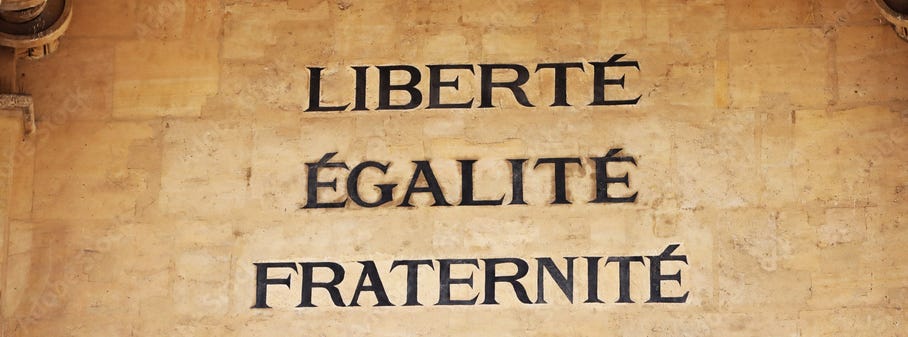
I don’t remember if Rorty mentions the national motto of France in his essay, but that’s what I thought of, and it occurred to me that while liberty and equality are values we Americans talk about all the time, fraternity is not. If anything we reject the idea of fraternity as incompatible with individual rights. It also occurred to me that the values of liberty and equality exist in mutual tension sometimes, pulling in opposite directions, and that fraternity might offer a resolution.
Fraternity means brotherhood in the literal sense, but in action the bond is expressed as mutual support. Another word for this is solidarity. The people of the Twin Cities have shown us a form of solidarity that is not only courageous and resilient but warm and welcoming. Writing in the Atlantic, Adam Serwer coined the term “neighborism” for it and summarized it this way:
Minnesotans are insisting that their neighbors are their neighbors whether they were born in Minneapolis or Mogadishu. That is, arguably, a deeply Christian philosophy, one apparently loathed by some of the most powerful Christians in America.
He contrasts this with the “blood and soil” nationalism favored by a faction of this country and oft expressed by J.D. Vance:
“Social bonds form among people who have something in common,” Vance said in a speech last July. “If you stop importing millions of foreigners into the country, you allow social cohesion to form naturally.” Vance’s remarks are the antithesis to the neighborism of the Twin Cities, whose people do not share the narcissism of being capable of loving only those who are exactly like them.
He also contrasts it with insincere virtue signaling:
A second MAGA assumption is that the left is insincere in its values, and that principles of inclusion and unity are superficial forms of virtue signaling. White liberals might put a sign in their front yard saying IMMIGRANTS WELCOME, but they will abandon those immigrants at the first sensation of sustained pressure.
And in Trump’s defense, this has turned out to be true of many liberals in positions of power—university administrators, attorneys at white-shoe law firms, political leaders. But it is not true of millions of ordinary Americans, who have poured into the streets in protest, spoken out against the administration, and, in Minnesota, resisted armed men in masks at the cost of their own life.
These represent obstacles to a future politics based on neighborism, as does a strain of American individualism that crosses over into a toxic selfishness. This shows up in debates about anything aimed at collective wellbeing—healthcare, SNAP, school lunches, free college, parental leave, public education, etc. It also appears in any conversation about protecting or helping anyone who is different or far away. It takes various forms of “who’s going to pay for it?” and “it doesn’t affect me, so why should I care?”
I don’t know whether this strain of selfishness is a fundamental and fixed mindset or a learned behavior—something to be circumvented versus something we can change in people. Either way, it seems like a politics of neighborism is what we will need as we endure some years of rupture, and it points a basis for a better future.
Further Reading
Here’s more on neighborism in the Twin Cities.
The Key to Minneapolis’s Successful ICE Resistance
Bonds formed under the pressure of negative double-digit windchill are key to understanding what’s happening. It is impossible to get through a Minnesota winter without help, and only sometimes does that assistance come from your neighbors. The stories about people shoveling out or snowblowing an entire block’s driveways without being asked and with no compensation are true, but the real miracles (and just as common) are the times when strangers stop to help someone shovel out a car caught in a snowbank or bring out the kitty litter from their trunk put there just for this kind of emergency.
Minnesota Resistance to ICE: A Visit in Solidarity
Stand With Minnesota: stories from Minnesotans about what life is like right now
Retailers Respond to ICE Raids with Mutual Aid, Fundraising, and Economic Blackout
In Minneapolis, community care is the model for resistance
Hungry families, ICE and secret grocery networks in Minneapolis
Inside the Hidden Network of Resistance in Minneapolis
From the Cambridge Dictionary, I first encountered “omnishambles” as the new name for one of my favorite podcasts (formerly "What Rough Beast”) with Virginia Heffernan and Cy Canterel.
These actions plus his friendliness towards Putin and other totalitarian regimes have revealed to our allies how fragile our promises were all along, how U.S. policy is ultimately subject to the caprices of one man, or perhaps to American voters. Meanwhile our Asian allies have watched all this and have begun to explore their own alternatives, including China. New alliances will develop, nominal and former allies will evict American military units based in their borders, and more countries will pursue nuclear armament. This is the start of a generational shift if not a permanent one.
Beyond the widespread economic injury this caused, the fact that the tariffs were nonsensical on every level just adds further insult. In response there has already been a reshuffling of global trade relationships, trending towards bilateral agreements and some larger shifts that favor China. These are structural—perhaps ideological—changes to curb U.S. leverage, which the next president won’t be able to undo.
Zuckerberg is reportedly “scaling back” work on the metaverse after spending roughly $80 billion on the boondoggle. But lest we think his obsession makes him a renegade dipshit, here are some snippets of what the supposedly smart folks at McKinsey projected would be the case by 2030:
50% of live events would be held in the Metaverse
80% of commerce would be impacted by in-Metaverse consumer activity,
Most learning and development would happen in the Metaverse,
Manufacturers and telecommunications companies may have virtually all assets and processes represented in the Metaverse,
The average internet user would spend six hours a day in the Metaverse,
The Metaverse would generate $5 trillion in value.
In one striking email exchange from 2015, Kathy Ruemmler (then one year removed from having been President Obama’s chief counsel) engages with Epstein about a confrontation between Senator Elizabeth Warren and SEC chair Mary Jo White. It’s worth reading this piece in The American Prospect about their exchange, but important to note is the picture it paints of M.J. White as a “pioneer of elite impunity” who made the protection of powerful people and corporations her professional mission. The fact that Epstein was looped into this situation at all speaks to the existence of an “Epstein class” and what that means in terms of power and impunity, and it hints at how much global dealmaking is probably happening in back channels, at the rest of our expense.
From his speech and subsequent pamphlet, War is a Racket
https://substack.com/@emermartin/note/c-239440351
Never stop talking about us.
One of your best, cousin